The Evolution of Safety by Design: Integrating Machine Risk Assessment Software into CAD Workflows
The modern paradigm of industrial machine design has rapidly evolved from static 2D mechanical drawings into dynamic, data-rich 3D digital ecosystems. Engineers now rely heavily on advanced Computer-Aided Design (CAD) and Model-Based Definition (MBD) to streamline the product lifecycle. However, while mechanical design has fully embraced digital transformation, the safety engineering and risk assessment processes have frequently lagged behind, often remaining siloed in disconnected spreadsheets.
To bridge this gap, the industry is increasingly turning to dedicated machine risk assessment software to bring safety evaluations directly into CAD-based workflows. This article explores the current state of mechanical design and safety engineering, the friction between them, and how AI-driven tools like HazardLens.ai are helping to solve these inherent workflow challenges.
The Current Mechanical Design Process
The lifecycle of an industrial machine design generally follows a structured, iterative phase-gate approach:
- Problem Identification and Feasibility: Engineers define the machine's functional requirements, operating constraints, throughput goals, and spatial limitations.
- Conceptual Design: Using CAD software, designers rapidly develop and iterate on 3D models. Advanced tools, including generative design algorithms, allow engineers to explore optimal geometries and mechanical movements before committing to a final concept.
- Detailed Engineering and Documentation: The concept transitions into precise engineering. Every component is modeled with manufacturing accuracy, often integrating Product Manufacturing Information (PMI) directly into the 3D model through Model-Based Definition (MBD). This semantic data creates a "single source of truth" for the machine's geometry, tolerances, and materials.
- Production Design: Finally, the CAD data is optimized for manufacturability and assembly (DFMA) and integrated into Computer-Aided Manufacturing (CAM) and Product Lifecycle Management (PLM) systems for seamless handoff to the production floor.
The Disconnect: Typical Risk Assessment and Safety Workflows
In parallel to mechanical design, safety engineering must ensure the machine complies with stringent global standards, most notably ISO 12100. The ISO 12100 risk assessment methodology follows a strict, logical sequence:
- Define Limits: Determine the machine's spatial, temporal, and use limits, including reasonably foreseeable misuse.
- Identify Hazards: Systematically locate all mechanical, electrical, and ergonomic hazards across every lifecycle phase.
- Estimate and Evaluate Risk: Score the risk based on the Severity of potential harm and the Probability of occurrence.
- Apply Risk Reduction: Utilize the mandatory 3-step method: (1) Inherently safe design measures, (2) Safeguarding and complementary measures, and (3) Information for use (warnings/manuals).
The Problem: Traditionally, the risk assessment and the technical CAD documentation are treated as separate entities. Safety evaluations are often conducted late in the design process, functioning more as a compliance "checkbox" recorded on a static Excel spreadsheet than an active engineering tool.
When safety is siloed from CAD, engineers often default to bolting on physical guards or relying on warning labels rather than designing hazards out of the machine fundamentally. Furthermore, late-stage safety additions can introduce "secondary risks", such as a newly added physical guard forcing a maintenance worker into an awkward, unsafe ergonomic posture to reach a component.
How Machine Risk Assessment Software and HazardLens.ai Solve the Problem
To implement true "safety by design," risk assessments must occur during the conceptual and detailed CAD phases. This requires a shift toward specialized machine risk assessment software that connects visual design data with regulatory safety standards.
Tools like HazardLens.ai illustrate how modern technology serves as an educational and practical bridge between the CAD environment and safety compliance documentation. Here is how this integration practically solves workflow bottlenecks:
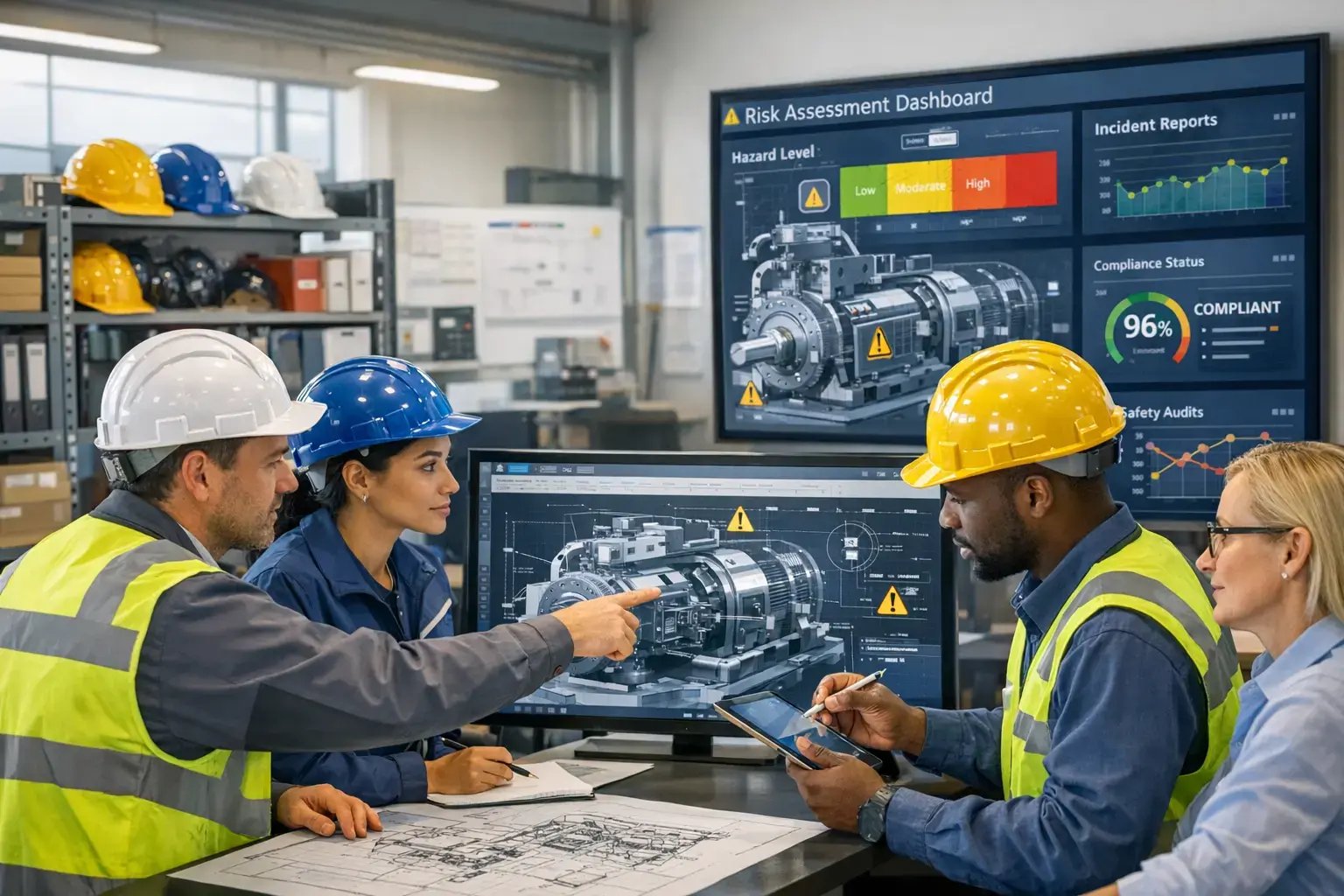
1. Early, Visual Hazard Identification Rather than waiting for a physical prototype or manually scanning complex 3D assemblies, engineers can export their CAD drawings or 3D models (as PDFs or standard image formats) directly into the software. HazardLens utilizes multimodal AI to analyze these visual inputs, instantly identifying common mechanical hazards, risk indicators, and relevant machine components with a high degree of reliability. This brings hazard identification into the iterative CAD phase, allowing engineers to spot and eliminate pinch points or crush zones before finalizing the design.
2. Standardized Risk Estimation Spreadsheets often suffer from subjective or inconsistent risk scoring. HazardLens.ai standardizes this by processing the identified hazards and suggesting risk parameters aligned with established models, evaluating factors like Severity (S), Frequency of exposure (F), Possibility of avoidance (P), and Probability of occurrence (O). This gives the design team an immediate, quantitative baseline for their current CAD iteration.
3. Guiding the 3-Step Risk Reduction Method When a risk is flagged, the software prevents the common pitfall of jumping straight to warning labels. Instead, it suggests risk reduction measures strictly following the hierarchy:
- Design Improvements: Inherently safe design changes to make directly in the CAD software.
- Protective Measures: Engineered solutions like fixed/removal guards, fencing, and safety components.
- Operational Controls: required additions to Safe Operating Procedures (SOPs), Information for Use, and User Manuals.
4. Human-in-the-Loop Expert Control and Audit Trails AI is a powerful assistant, but machine safety requires the nuanced judgment of a qualified safety professional. Modern machine risk assessment software is designed so that all AI-generated hazards and mitigations are 100% editable. The software acts as a dynamic repository that tracks the audit trail of decisions showing why a risk was deemed acceptable or how a specific CAD change mitigated a hazard, rather than just presenting a final, contextless spreadsheet score.
Conclusion
As industrial machinery grows more complex, the historical divide between mechanical design and safety compliance is no longer sustainable. By leveraging machine risk assessment software, engineering teams can transition from reactive, spreadsheet based safety checks to proactive, AI-assisted safety engineering. Identifying and designing out hazards directly from CAD exports not only ensures rigorous compliance with standards like ISO 12100 but also reduces costly late-stage redesigns, ultimately yielding a safer, more efficient manufacturing ecosystem.